
Before You Puncture the Skin: Why IV Success Starts with Assessment
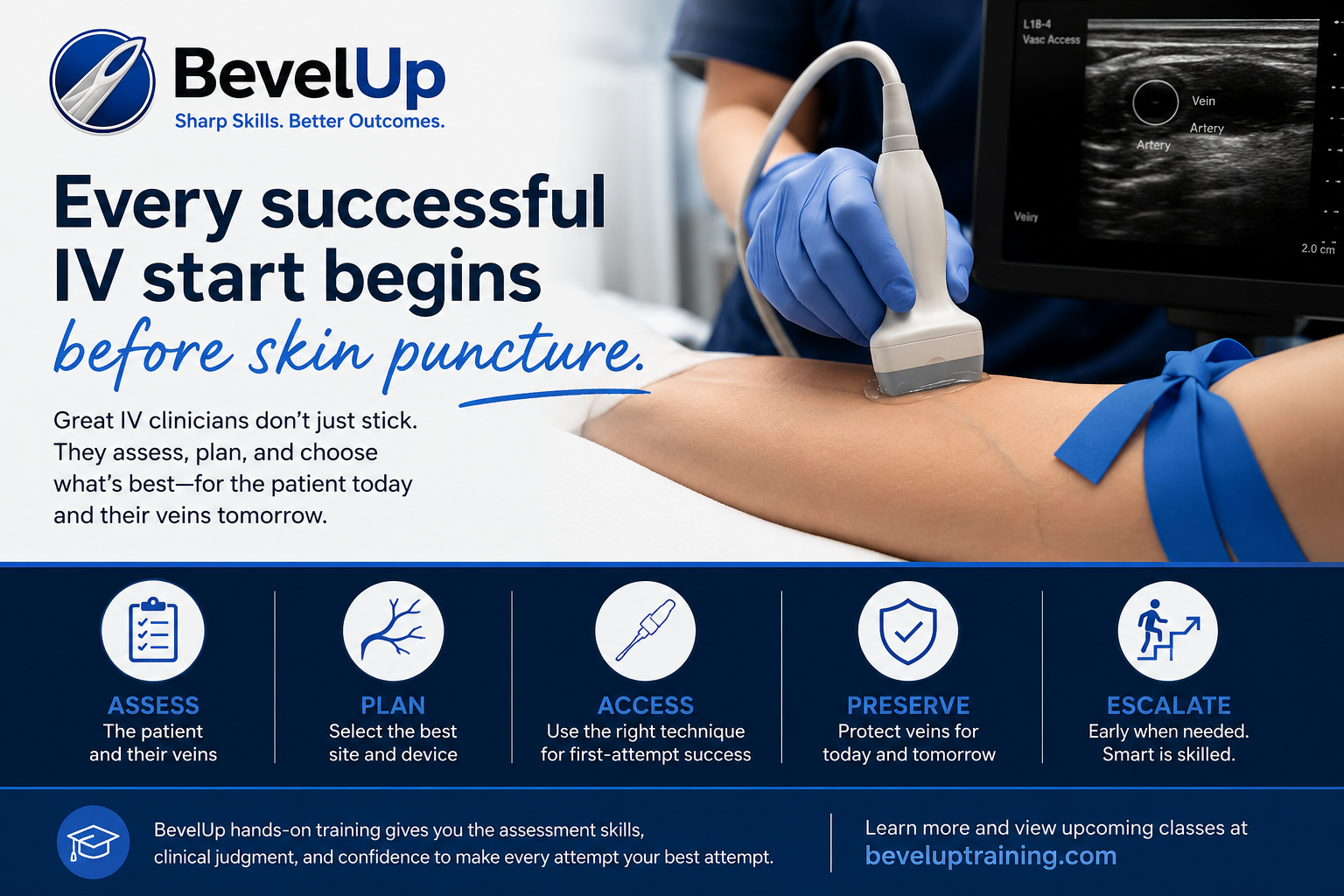
It’s tempting to believe that successful peripheral IV insertion is all about technical skill. Many clinicians spend countless hours refining their needle angle, stabilizing their catheter, and perfecting their insertion technique. While those skills are essential, they are only part of the equation.
The reality is that most failed IV attempts are not caused by poor needle control—they are caused by poor assessment.
The best clinicians don’t simply start IVs. They assess the patient, evaluate the veins, consider the therapy, and develop a plan before opening the catheter package. That thoughtful approach improves first-attempt success, preserves veins, reduces patient discomfort, and supports better clinical outcomes.
Assessment Is More Than Finding a Vein
When clinicians hear the word “assessment,” they often think about locating a visible or palpable vein. But comprehensive vascular assessment involves much more.
Before selecting a site, ask yourself:
Why does this patient need vascular access?
What medications or fluids will be infused?
How long will therapy continue?
What is the condition of the patient’s veins?
Does this patient have a history of difficult vascular access?
Is a peripheral IV the most appropriate device?
These questions guide every decision that follows.
A technically perfect insertion into the wrong vein is still the wrong decision.
Start with the Patient
Every patient presents unique challenges and opportunities.
Age, hydration status, chronic illness, obesity, edema, chemotherapy, previous vascular access devices, and repeated venipuncture all influence vessel quality.
Some patients have veins that appear ideal but are fragile and prone to infiltration. Others may have few visible veins but excellent ultrasound targets.
Assessment begins before the tourniquet is applied.
Observe.
Listen.
Ask questions.
Learn from the patient’s history.
Look Beyond Visibility
Visible veins can be deceiving.
A prominent superficial vein may be heavily scarred, tortuous, or partially thrombosed. Conversely, a deeper vein that cannot be seen may provide a safer, more durable access site.
High-quality assessment includes evaluating:
Vein diameter
Compressibility
Depth
Straight segment length
Branching patterns
Vessel health
Previous puncture sites
Presence of valves
Choosing the healthiest vein—not merely the easiest vein—supports vessel preservation and long-term vascular access.
Device Selection Is Part of Assessment
One of the most common mistakes in vascular access is assuming every patient needs a standard peripheral IV catheter.
Instead, begin with the therapy.
Consider:
Expected duration of treatment
Medication characteristics
Osmolarity and pH
Irritant or vesicant potential
Frequency of blood sampling
Future vascular access needs
Sometimes the correct decision is a peripheral IV.
Sometimes it is a longer peripheral catheter.
Sometimes a midline or PICC is more appropriate.
Good assessment often prevents unnecessary restarts and protects the patient’s remaining vascular access options.
Preserve Veins for Tomorrow
Every unsuccessful IV attempt has consequences.
Repeated punctures increase patient anxiety, delay treatment, consume staff time, and damage vessels that may be needed later during hospitalization.
Vein preservation should be considered during every assessment.
Whenever possible:
Preserve larger proximal veins for future access.
Avoid unnecessary punctures.
Rotate sites appropriately.
Select the smallest catheter that safely supports the prescribed therapy.
Escalate early when landmark techniques are unlikely to succeed.
Thinking beyond today’s IV benefits the patient throughout their course of care.
Know When to Escalate
One of the hallmarks of expert practice is recognizing when a different approach is needed.
Escalation is not failure.
It is sound clinical judgment.
Patients with obesity, chronic illness, edema, vascular depletion, or a history of difficult access often benefit from early ultrasound assessment rather than repeated blind attempts.
Likewise, some therapies warrant consideration of alternative vascular access devices from the outset.
Successful clinicians continually ask:
“Is this still the best approach for this patient?”
Assessment Improves Patient Experience
Patients rarely remember the gauge of the catheter you inserted.
They remember whether the experience was painful, whether multiple attempts were required, and whether they felt confident in your care.
Thoughtful assessment leads to:
Higher first-attempt success
Less pain
Fewer complications
Greater patient confidence
Improved workflow
Better stewardship of the patient’s veins
These outcomes matter just as much as technical proficiency.
Build a Consistent Assessment Framework
The strongest clinicians don’t rely on instinct alone.
They use a repeatable process that guides every vascular access decision.
At BevelUp, we teach clinicians to evaluate the patient, assess vessel health, match the device to the therapy, recognize when escalation is appropriate, and approach every insertion with a deliberate plan.
Assessment becomes a habit—not an afterthought.
Final Thoughts
Technical skill will always be important.
But skill without assessment often leads to unnecessary failures.
Before every insertion, pause.
Assess the patient.
Assess the therapy.
Assess the veins.
Then choose the best device and the best approach.
Because every successful IV truly starts before the needle touches the skin.
Ready to Improve Your First-Attempt Success?
BevelUp’s Peripheral IV Insertion: Principles & Practice course is designed for nurses and clinicians who want to build confidence through evidence-based assessment, thoughtful device selection, and hands-on practice.
You’ll learn to:
Perform a systematic vascular assessment
Select the most appropriate vein and catheter
Improve first-attempt success
Recognize when to escalate to ultrasound or another vascular access device
Apply current standards and best practices to everyday clinical care
Whether you’re new to vascular access or looking to refine your practice, our goal is simple: help you make every attempt your best attempt.